
Tillerson said the US will provide India with best technologies for its military modernisation which include offers to supply F-16 and F-18 fighter jets.
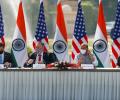
Henry Kissinger once said, 'It may be dangerous to be America's enemy, but to be America's friend is fatal.' India will have to wait and see, observes Rajeev Srinivasan.

The former Chief of Army Staff said India faces the most complex threats and challenges spanning a full spectrum of possible conflict -- from nuclear to sub-conventional -- but asserted that the armed forces are ready to deal with them.

Initial indications that the perpetrators of this attack were Pakistani and that the attack emanated from Pakistan, says US Senators.

As deputy governor, Patel headed the RBI panel to draft the monetary policy report, which became the basis of the ongoing reforms at the apex bank
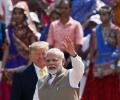
'Flattering press, nice photos, no major gaffes.' 'Both sides will be very happy as they are clearly measuring 'success' by a different yardstick than the world used in the past.'

We can expect to see more Chinese wolf warrior diplomats on the prowl, in India's neighbourhood, though its mailed fist is not so visible while dealing with India, observes Colonel R Hariharan (retd).

This is the joint statement issued by the ministry of external affairs on the visit of US President Barack Obama to India.

India has become the 37th country to join the list of Strategic Trade Authorization-1 category, the only South Asian nation.

The prime minister and president stated their intention to expand defence co-operation to bolster national, regional and global security.

'Here in Delhi, the Modi government is supposedly looking at 'options' to hit back at Pakistan in any whichever way it can, while in Washington, the Obama administration is looking for ways to strengthen US military cooperation with Pakistan,' says Ambassador M K Bhadrakumar.

Juster, 62, is an old India hand who played a key role in the landmark Indo-US civil nuclear deal.

'There is little appetite in the Democratic foreign policy establishment to pick a fight with India.'

US Congresswoman Tulsi Gabbard, newly elected co-chair of the influential Congressional Caucus on India and Indian-Americans, discusses her vision for US-India ties with Rediff.com's Monali Sarkar.
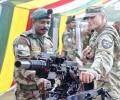
Acknowledging that it is clear to all that many terrorist groups operate in Pakistan, he said the US continues to work with the Pakistani government in this regard.

The joint statement issued after Prime Minister Narendra Modi and President Barack Obama's first-ever summit is high on intent and ambition. Notably missing from the statement is India's refusal to be America's partner in its war against ISIS.
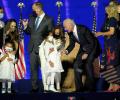
'The credit for managing Trump should go to Modi.' 'Biden is a predictable and rational person with plenty of administrative experience,' notes Ambassador T P Sreenivasan.

The reduction of tension on the Chinese border may have reduced the urgency of a Biden-Modi meeting, but the sooner Modi starts a bromance with Biden the better as he had done with Obama and Trump, suggests Ambassador T P Sreenivasan.

'It is in the interest of both sides that the visit of the US President is seen as being successful. Both sides have invested considerable political capital in it. This rapid exchange of visits and the decisions taken have to be justified, beyond the symbolism, which is no doubt important in itself. This opportunity to impart a fresh momentum to ties should not be missed,' says former foreign secretary Kanwal Sibal.

The start of Indian lobbying in the US can be traced back to Pakistan's anti-India lobbying. Policy wonk Ashok Sharma documents this journey and its catalytic role in transforming the US-India relationship.

Indians at large harbour a notion that their country is cherrypicking out of the American basket of goodies, but the policymakers in Delhi and the political leadership are well aware that it can only be a pipe dream since a military alliance with a superpower is a profound irrevocable commitment, observes Ambassador M K Bhadrakumar.
Led by Ajay Shriram, chairman and senior managing director, DCM Shriram, the CEO's delegation seeks to convey to their American counterparts the sense of optimism amongst Indian industry.

The USS John Paul Jones acted like a dog marking the lamp post, observes Ambassador M K Bhadrakumar.

Had India agreed to join the trade pact, Indian markets would have been flooded with cheap Chinese products.

'Progress demands regular senior-level attention from American leaders.' 'A leaders' summit is great, but we need sustained engagement to continue to forge new agreements and find new areas of cooperation.'

Indian-American business leaders meet to discuss ways to make this initiative a success.

"Every action we take will be designed to ensure our military is ready to fight today and in the future," Mattis said on Friday in a message to department of defense soon after he was being sworn in as head of the Pentagon by Vice President Mike Pence at the White House.

'We're going to see a defence relationship that really takes off -- now that India is a major defence partner of the US, the sky is the limit for arms sales.' 'The economic partnership will lag behind the security relationship, but the meeting and joint statement give cause to believe that it will progress more robustly than many of us would have expected.'

Vajpayee had always felt that India must act with conviction and panache. He decided that, irrespective of the attendant risks, he would undertake what many felt was a precarious course. A fascinating excerpt from N K Singh's Portraits Of Power: Half A Century Of Being At Ringside on Atalji's 96th birthday, December 25.

US companies are 'positively looking' at India.

Immediately after India launched its surgical strikes, sources said, it had informed the US of its action.

"We have many relationships...they have a history. We will do what is in our national interest and part of that strategic partnership is the ability of each country to comprehend and appreciate the national interest of the other," Jaishankar said.

'... For the India-US relationship to continue its positive trajectory, it will require India to adapt to a different approach.' Nisha Desai Biswal -- who as the Obama administration's point person for South Asia was in the inner circle of all the Obama-Modi Summits -- tells Rediff.com's Monali Sarkar why she is hopeful that India and the US are on an irreversible forward course.

'India must close the missile technology gap with both China and Pakistan as early as possible, or else the credibility of India's nuclear deterrence will remain suspect,' says Brigadier Gurmeet Kanwal (retd).
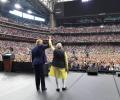
The US seems to be engaging in a game of brinkmanship where President Trump's visit has been used as 'leverage' to pressure India into agreeing to a trade deal, notes Kashish Parpiani.

Jaishankar said that the resolution on Kashmir introduced by Jayapal in the House is not a fair characterisation of the situation in J-K. And also said that he has no interest in meeting the Congresswoman.

'If the US-Pakistan relationship continues to suffer, Pakistan may feel it has less to lose and decide that it need not keep a leash on LeT in order to appease America.' 'A tougher US policy toward Pakistan could lead to an emboldened and strengthened LeT and JeM, resulting in more terrorist attacks in India.'

Aziz Haniffa, who has covered every Indian Prime Minister's visit to the US since Rajiv Gandhi in 1985, gives us a peek into what's happening in Washington, DC on the eve of the Modi-Trump summit.

India comes under attack over religious intolerance, human trafficking and slavery at a Senate Foreign Relations Committee hearing.

Recognising the threat posed by outfits like the Al Qaeda, Lashkar-e-Tayiba and the Dawood Ibrahim network, India and the United States have agreed to deepen cooperation in fighting terrorism and asked Pakistan to bring to justice the 2008 Mumbai attack perpetrators.
